
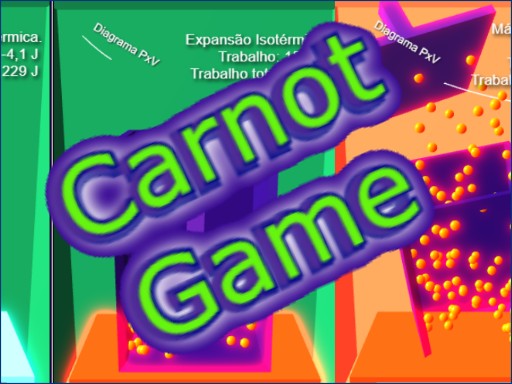
Play Carnot Game - Casual Physics Now:
Note: Game may take a few moments to load. Click the on-screen button to switch between thermal sources.
Quick Facts:
- Genre: Educational / Physics Simulator / Hypercasual
- Platform: HTML5 (Play in browser)
- Controls: One-touch / Click to switch sources
- Core Concept: Interactive Carnot Cycle Simulation
- Key Features: Physics-based gameplay, Thermal source management, Score based on cycle efficiency, Risk of explosion/freezing.
- Tags: 3D, Educational, Hypercasual, onetouch, Physics, Science, Simulation, Simulator
Introduction to Carnot Game - Casual Physics
Dive into the fascinating world of thermodynamics with Carnot Game - Casual Physics, an innovative and interactive HTML5 game designed to make learning about the Carnot Cycle engaging and fun. In this unique simulation, players take control of a system featuring a cylinder and piston, with the primary objective of maximizing the work done. This is achieved by strategically alternating between three thermal sources: hot, insulator, and cold. The challenge lies in maintaining the piston's operation as close to the ideal Carnot cycle as possible, making precise transitions between sources to avoid catastrophic failures like the cylinder exploding or freezing. The closer you adhere to the ideal cycle, the higher your score and progress will be.
This game cleverly transforms a fundamental physics concept into an accessible hypercasual experience, testing both your understanding and your timing in a bid for thermodynamic efficiency.
Gameplay Mechanics
Core System: Managing Thermal Sources
The gameplay in Carnot Game revolves around a simple yet crucial mechanic: managing the thermal state of a cylinder to optimize piston work. Players interact with the system by:
- One-Touch Control: Clicking a button to switch the cylinder's contact between a hot thermal source, an insulator, and a cold thermal source.
- Maximizing Work: The core goal is to make the piston perform as much work as possible by following the Carnot cycle's stages.
- Timing Transitions: Success hinges on switching between the thermal sources at the precisely correct moments in the piston's cycle.
- Avoiding Failure: Mistimed transitions can lead to the piston jamming, the cylinder overheating and exploding, or overcooling and freezing, ending the game.
- Score & Progress: Performance is measured by how closely the player's actions mimic the ideal Carnot cycle, directly impacting their score and ability to progress.
The Carnot Cycle Challenge
The game is built upon the principles of the Carnot cycle, which consists of four distinct thermodynamic processes that players must navigate:
- Isothermal Expansion: Absorbing heat from the hot source while the gas expands.
- Adiabatic Expansion: Expanding the gas without heat exchange (using the insulator).
- Isothermal Compression: Rejecting heat to the cold source while the gas is compressed.
- Adiabatic Compression: Compressing the gas without heat exchange (using the insulator) to return to the initial state.
Mastering the timing for each of these four transitions is the key to achieving high scores and understanding the cycle's efficiency.
Educational Value and Strategic Depth
Carnot Game offers a unique blend of casual gameplay with significant educational merit and surprising strategic depth. It’s not just about random clicks; it’s about understanding a fundamental scientific principle:
| Cycle Phase | Player Action | Goal / Risk |
|---|---|---|
| Isothermal Expansion | Switch to HOT source at max compression. | Maximize heat input for work / Switch too late, pressure drops. |
| Adiabatic Expansion | Switch to INSULATOR at max expansion from hot. | Cool gas by expansion without heat loss / Switch too early/late, lose potential work. |
| Isothermal Compression | Switch to COLD source at max expansion. | Minimize work needed for compression / Switch too late, re-heats. |
| Adiabatic Compression | Switch to INSULATOR at max compression from cold. | Return gas to initial high temperature / Switch too early/late, miss target state. |
The game encourages players to develop an intuitive feel for these thermodynamic processes, reinforcing learning through active participation and immediate feedback on their decisions.
Visuals and Atmosphere
Carnot Game likely employs a clear, 3D visual style typical of educational simulators and hypercasual games, focusing on functionality and understanding:
- A straightforward representation of the cylinder, piston, and thermal sources.
- Visual indicators for temperature, pressure, and piston movement to help players make informed decisions.
- Distinct visual feedback for successful cycle phases versus failure states (e.g., an explosion or freezing effect).
- The "onetouch" and "hypercasual" nature suggests a clean, uncluttered interface, making it easy to focus on the core mechanic.
The atmosphere is one of focused concentration, where precision and understanding are rewarded, and mistakes have immediate, visible consequences.
Tips and Strategies
To excel in Carnot Game and truly master the cycle, consider these physics-savvy tips:
Understand the Cycle
Familiarize yourself with the four stages of the Carnot cycle. Knowing what *should* happen next is key to timing your switches.
Watch the Piston Closely
The piston's position (fully extended, fully compressed) is your primary cue for when to switch thermal sources.
Learn from Mistakes
If the cylinder explodes or freezes, analyze what went wrong. Did you switch too early or too late? Adjust your timing accordingly.
Final Verdict
Carnot Game - Casual Physics is a commendable effort in gamifying a complex scientific concept. It cleverly distills the Carnot Cycle into an engaging one-touch experience that is both challenging and educational. The direct feedback loop of action and consequence (high score vs. system failure) effectively reinforces the principles of thermodynamics in an accessible format. It’s a great tool for students or anyone curious about physics who prefers interactive learning.
Platform: HTML5 (Playable in most modern browsers)
Recommended for: Students of physics/engineering, educators looking for interactive tools, fans of hypercasual games with a strategic twist, and anyone interested in science simulations.
Carnot Game - Casual Physics successfully makes a challenging topic approachable and even fun. By focusing on timing and the direct consequences of managing thermal energy, it provides a tangible way to understand the efficiencies and pitfalls of the Carnot cycle. If you're looking for a brainy hypercasual game that might just teach you something profound about how the universe works, give this one a click!
⚙️ Platform Tech Specs
- Platform: Blogger
- Category: Games
- Current Theme: Amazen 4.0
- Developer: Moha Boko
- Looking for a similar theme? Visit KalibNet for a selection of top games themes.